Last updated November 18, 2026








Free written scope consultation - allowances, timeline, and change-order rules on paper before a single trade is scheduled
General Contractor Maintenance Schedule: What to Do and When
Most remodeling warranties are written to expire right before the problems they cover would normally show up. That’s not bad luck. It’s the standard retail warranty calendar, and it works against you if you don’t know the actual failure timeline of a house. Caulk fails at month 8 to 14. Grout cracks at month 6 to 10. Door frames bind during the first full clay cycle. We’ve spent years watching McKinney homeowners discover this the hard way, standing in a bathroom with a soft spot in the floor tile and a warranty that lapsed eight months ago. This guide gives you the schedule your contractor should have handed you at close: the 30-day walkthrough, the 11-month inspection, the 3-year review, and the annual trade-by-trade checklist that keeps a solid remodel from turning into a five-figure repair.
Quick Answer
A remodel maintenance schedule has three critical checkpoints: a 30-day walkthrough to catch caulk, grout, and door-swing issues while they’re still under warranty, an 11-month full inspection done before the one-year workmanship guarantee expires, and a 3-year review of anything that moves or seals (doors, windows, exterior caulk, faucets). Between those, a full annual room-by-room inspection catches the seasonal wear that North Texas clay soil drives every year.
Styles & brands we work with
- Kitchen remodeling
- Bathroom remodeling
- Home additions & ADU
- Roofing
- Windows & doors
- Driveway & pavers
- Fence
Table of Contents
- Why the Failure Timeline Matters More Than the Checklist
- The 30-Day Walkthrough: What to Look For
- The 11-Month Mark: Your Most Important Date
- How McKinney’s Clay Soil Sets the Annual Schedule
- Maintenance Item or Latent Defect? The Texas Line
- Room-by-Room Annual Inspection by Trade
- The 3-Year Review
- Common Mistakes to Avoid
Why the Failure Timeline Matters More Than the Checklist
A remodeling project isn’t finished on the day the last trim board goes up. It’s finished when the materials have gone through a full year of settling, expanding, contracting, and getting used. That’s the window where most workmanship problems actually appear, and it’s also the window most homeowners ignore because nobody told them to watch it.
Here’s the pattern, in plain terms. A caulk joint at a tub surround has an expected service life of about 8 to 14 months in a wet, interior environment. Grout in a shower floor cracks at month 6 to 10 as the substrate finishes its initial movement. A door slab that swings freely in March binds by August, once the clay soil under the slab has dried and shifted. Exterior caulk around a James Hardie-sided wall holds its seal for 5 to 7 years with proper application.
None of these are defects on day one. They become defects if nobody’s paying attention when they show up. The maintenance schedule below is built around those windows, not around a calendar. It’s the same sequence we walk every homeowner through at close, because the alternative is a homeowner finding a problem at month 14 with no recourse.
The other piece of the timeline is warranty alignment. A 365-Day Done Right Promise covers a full year of workmanship, which overlaps neatly with the two highest-failure windows (caulk and grout). Anything past day 366 is on you unless it’s a latent defect, and a latent defect is a much narrower category than most people assume. The schedule keeps you inside the covered window rather than chasing a fix after it closes.
The 30-Day Walkthrough: What to Look For
The 30-day walkthrough is the one most homeowners skip, and it’s the cheapest one to do. At 30 days, the house has been through one full month of real use. Showers have run. Doors have opened a few hundred times. The HVAC has cycled in and out. Any issue that needs a return visit is small and covered.
Do the walkthrough yourself, in person, with a phone flashlight and a notebook. It takes about 45 minutes.
- Caulk joints at wet areas. Run a finger along the tub, shower perimeter, and sink backsplash. Any separation, discoloration, or soft spot where a fingernail sinks in needs a note. A hairline crack at the tub-to-floor joint is common and expected; a gap you can see daylight through is not.
- Grout lines in the shower floor and any tiled wet surface. Look for cracks, especially at change-of-plane joints (wall-to-floor, floor-to-curb). Cracks there are a sign the substrate is moving.
- Door swing and latch. Open and close every door in the house. The latch should catch easily. Any rubbing at the top corner or a hard close means the door has shifted, which is normal settling but should be adjusted within the workmanship window.
- Window operation. Open and close every window you can. Sticking at the sashes is fine to note; a window that won’t latch is not.
- Cabinet doors and drawers. Open and close every door and drawer in a KraftMaid or Wellborn kitchen. Any that rub, misalign, or fail to self-close need an adjustment visit.
- Floor transitions. Walk every threshold and transition strip. Any movement underfoot or lifting edge is a note.
- Mechanical check. Look at the water heater connections, the under-sink supply lines, the HVAC condensate line, and the exterior hose bibs. Any moisture, staining, or weeping is a stop-and-note item (see the plumbing section below for what not to touch yourself).
Send the list to your contractor in writing, with photos, and ask for a return visit to correct items that fall under the workmanship guarantee. Get the response in writing too.
The 11-Month Mark: Your Most Important Date
The 11-month mark is the single most important date on your warranty calendar. Most one-year workmanship guarantees expire on a fixed calendar date, and the 30 days after expiration are when homeowners usually discover the problem. Catch it at month 11 and you’re inside the window. Catch it at month 12 and a half and you’re arguing.
The 11-month inspection is a dressed rehearsal of the 30-day walkthrough, plus a much closer look at anything seasonal. By month 11, the house has been through a full clay cycle in North Texas, meaning winter moisture, spring expansion, summer dry-out, and fall contraction. That’s when you find the things that move.
What to put in writing to your general contractor:
- A dated inspection statement: “Performing the 11-month walkthrough on [date] at [address],” with a list of items identified.
- Photo of each item, with a tape measure or coin for scale where relevant.
- A request for a written response within 10 business days stating which items will be corrected under the workmanship guarantee and which are considered homeowner maintenance.
- A second inspection scheduled within 14 days of any correction, to confirm the fix held.
If your contractor offers a 365-Day Done Right Promise, the 11-month walkthrough is exactly the tool that promise was designed for. If a caulk joint fails at month 10, that’s covered. If the caulk shows normal wear at month 14, that’s the homeowner’s maintenance schedule beginning. The 11-month date is where the two overlap. Our McKinney contractor team schedules this walkthrough with every homeowner at close, and the paper trail it produces is what makes a return visit a formality rather than a negotiation.
How McKinney’s Clay Soil Sets the Annual Schedule
McKinney sits on expansive clay soil, and that one fact organizes the maintenance year more than anything else on this list. The clay holds water and swells, then dries and shrinks. The house doesn’t move exactly with it, but the foundation, the door frames, the window openings, and the exterior caulk all ride that cycle with a predictable seasonal rhythm.
The rhythm goes roughly like this:
- February through April: soil moisture peaks, the clay swells, the foundation lifts slightly. Interior doors start to bind at the top of the frame. This is when you’ll get the call about a door that “won’t close.” It’s not a defect. It’s the season.
- June through September: soil dries and shrinks, the foundation settles. Doors release. Exterior caulk starts to pull away at joints where movement is greatest, especially at siding penetrations and window corners.
- October through December: the cycle reverses. Hairline cracks in exterior masonry and stucco show up. Caulk that was applied in spring and not rated for movement starts to split.
In our experience, McKinney homeowners on a reliable annual inspection schedule catch foundation-related frame movement early and adjust doors and hardware before anything binds permanently. Homeowners who skip it routinely discover the same movement as a cracked slab tile at year 3, which is a much bigger job.
Two practical habits: keep the soil around the foundation evenly moist during dry spells (a soaker hose set 18 inches from the foundation, run in summer, is the common McKinney fix), and schedule your exterior caulk inspection for late spring and late fall, which matches the two biggest movement events of the year.
Maintenance Item or Latent Defect? The Texas Line
Texas property law draws a real line between a maintenance item and a latent defect, and getting the language right is what decides whether your contractor is obligated to come back. It’s also the single most common source of friction between a homeowner and a general contractor on a completed job.
A maintenance item is normal wear on a component that has a finite service life. Caulk failing after 12 to 18 months of use, grout darkening in a shower floor, a door hinge that starts to squeak, a paint touch-up at a baseboard. The homeowner owns maintenance items, and the contractor has no obligation to return at no charge.
A latent defect is a defect in the original workmanship or materials that isn’t visible or discoverable at the time of substantial completion but shows up later. A shower pan that wasn’t properly sloped and starts to leak at year 2. A tile set on a substrate that wasn’t prepped to spec and cracks in a line. A window installed without flashing that leaks at the first heavy rain. Those are latent defects, and they fall outside a one-year workmanship window under Texas law.
Practical consequences:
- Documentation matters on both sides. A dated photo of the failing component, plus the original written scope, is what distinguishes one from the other.
- Written scopes with real trade language (“substrate prepped to manufacturer spec,” “shower pan sloped to drain”) make the latent-defect argument provable. A vague scope (“install tile”) does not.
- Homeowners should not try to fix a suspected latent defect themselves, or the argument collapses. Photograph, document, and call the contractor.
We write every scope with the trade language in it, and we put the written price and the guarantee terms in the homeowner’s hand before the first tool comes out. It’s the difference between having an argument and having a contract. You can see how that works on our General Contractor in McKinney page.
Room-by-Room Annual Inspection by Trade
The annual inspection is best done room by room, but organized by trade, because that’s how problems actually behave. Structural issues show up at the frame. Mechanical issues show up at the HVAC and the water heater. Plumbing issues show up at the supply and drain connections. Finish issues show up at the caulk and paint. Run the list once a year, ideally in early fall, before the heating season exposes anything hidden.
Framing and structural
- Walk the perimeter and note any new cracks in drywall at door and window corners. Small hairline cracks are cosmetic. Stair-step cracks wider than a credit card are a call-a-professional item.
- Check every door swing. Adjust hardware before the binding becomes permanent.
- Check the attic for new staining at roof penetrations, especially after a hailstorm.
Mechanical (HVAC and water heater)
- Change the HVAC filter on the schedule the unit specifies. Note the condensate line for leaks or clogs, especially in summer.
- Flush the water heater per manufacturer spec (typically annually in McKinney’s hard-water conditions).
- Look at the water heater and HVAC connections for staining or weeping, but don’t open a gas line or an electrical panel yourself. Those are trained-professional items, full stop.
Plumbing
- Run every faucet and check the supply lines under each sink for corrosion or moisture.
- Check the toilet seals and the shower drain. Slow drains and a rocking toilet are early warning signs.
- Look at the washing machine supply hoses; replace if there’s any bulge or stiffness.
- Do not open a pressurized supply line or attempt to remove a shower valve cartridge yourself. That’s a plumber’s job, and a misstep there is a flooded floor.
Finish work
- Re-caulk any joint with a gap or discoloration. Caulk is a wear component; plan to replace it every 2 to 5 years depending on the location.
- Check the paint at exterior doors, window trim, and James Hardie siding penetrations. Any blistering or peeling is moisture behind the paint.
- Inspect the kitchen backsplash and tile grout for cracks. Touch up with matching grout rather than re-caulking.
- Check your cabinetry hardware and door alignment; a five-minute adjustment once a year prevents a soft-close mechanism replacement.
The 3-Year Review
By year 3, the house has been through three full seasonal cycles, and the maintenance items start to outnumber the covered ones. This is the review where you move from “still under warranty” mode to “long-term ownership” mode, and the work shifts from protecting the workmanship to protecting the components.
What the 3-year review covers:
- Full re-inspection of every caulk joint and grout line, with replacement rather than touch-up where the material has failed.
- Exterior envelope review: siding condition, window flashing, door thresholds, and the caulk at all penetrations. James Hardie siding holds well in North Texas, but penetrations still need re-sealing.
- Any deferred items that appeared in the 11-month inspection and were marked homeowner maintenance. If they haven’t been dealt with by now, they’re the ones to prioritize.
- A budget review for the next five years: which finishes will need replacement, and what the realistic cost is in McKinney’s market.
Three years is also when a homeowner is most likely to be planning the next project. If the kitchen from 2015 is heading for a remodel, the 3-year review is the natural planning session. You can see how we scope that work on our Kitchen Remodeling in McKinney page, and what the same process looks like for a bath on our Bathroom Remodeling in McKinney page. The checklist above is the same one that goes into every project’s close package.
Common Mistakes to Avoid
- Skipping the 30-day walkthrough because “it’s still new.” The 30-day mark is the easiest one to correct, and the one most likely to be covered with no argument. Skip it and the same caulk failure at month 9 becomes a maintenance item.
- Doing the 11-month inspection at month 13. One year means 12 months. By month 13, the workmanship window is closed, and the argument changes from “come fix it” to “who’s responsible.” Set a calendar reminder the day you sign the close-out paperwork.
- Treating a seasonal door bind as a defect. McKinney’s clay soil moves the frame. A door that binds in April and releases in October has moved with the house, not failed. Adjust it, note it, don’t file a warranty claim over it.
- Re-caulking a joint with the wrong product. Kitchen and bath caulk isn’t the same as exterior caulk, and neither is a substitute for tiling grout. Using the wrong product causes a repeat failure and can void a finish warranty on cabinetry or tile.
- Attempting latent-defect corrections yourself. Touching a suspected workmanship defect, especially in a shower pan or a tile substrate, removes the documentation that makes the claim provable.
- Letting the roof go unmanned between inspections. Hail is routine in McKinney, and roof penetrations show staining before they leak. Look at the attic after every significant storm, not just once a year.
- Opening a panel or a gas line to “have a look.” Electrical panels and gas lines are trained-professional territory. A cosmetic look at a water heater connection is fine; cracking a gas union is not.
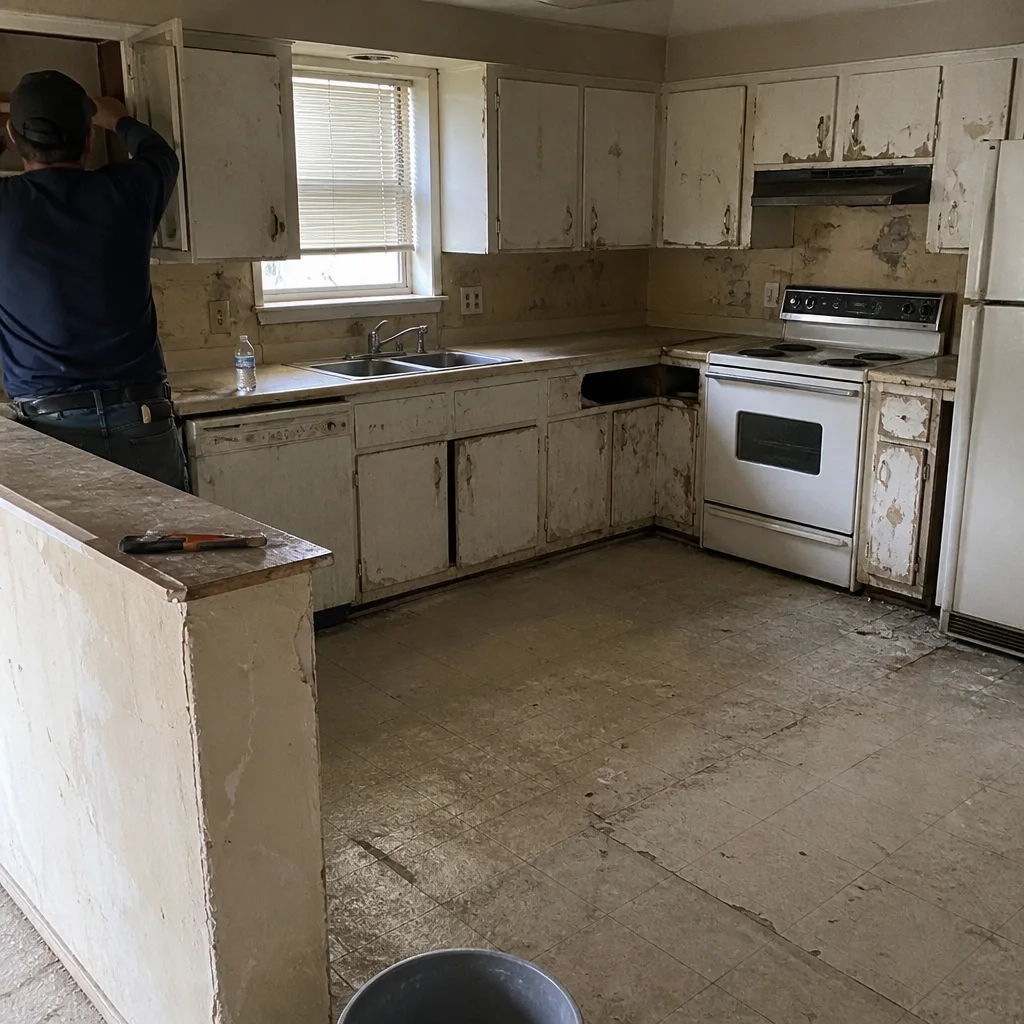
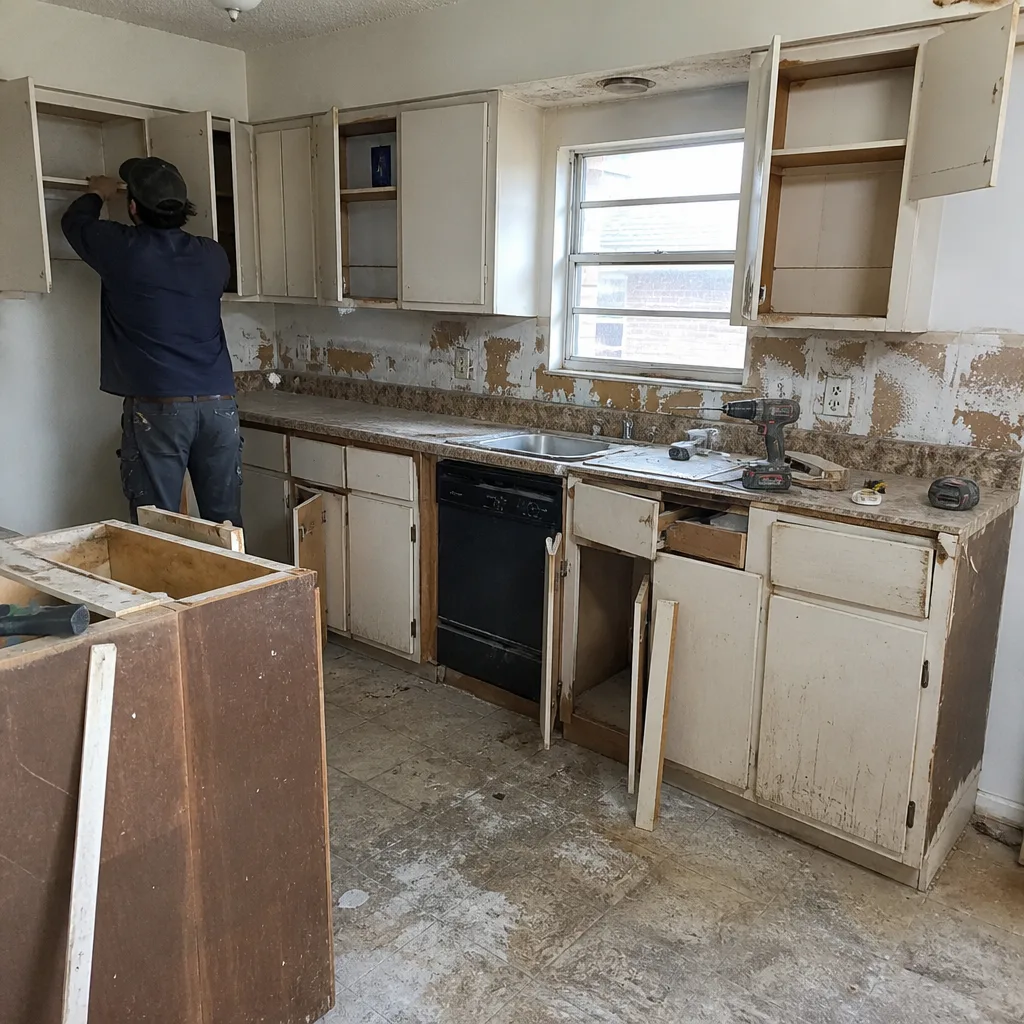
See the difference
 Before
 After
 Before
 After
 Before
 After
When to Call a Professional

Some maintenance items are homeowner work, and some are not. Re-caulking a tub surround, tightening a cabinet hinge, changing an HVAC filter, and adjusting a door strike are all fine to do yourself. Anything involving an electrical panel, a gas appliance connection, a pressurized supply line, a suspected foundation issue, a soft spot in a floor, or a moisture stain that keeps returning should be a call.
The judgment call is usually the one homeowners get wrong: a soft spot in tile, a slow drain that returns after snaking, a hairline crack that keeps widening. Those read as cosmetic and usually aren’t. The cost of a professional assessment is small compared to waiting another season. If your project is still inside the 365-Day Done Right Promise, call before day 366. Bradford Remodeling Co McKinney offers free estimates in McKinney – call (844) 834-0609, and a live person picks up.
Frequently Asked Questions
Do a full walkthrough at 30 days, a formal inspection at 11 months (before the one-year workmanship guarantee expires), and a full room-by-room review once a year after that. The 11-month inspection is the most important one because it happens inside the warranty window.
Send a dated inspection statement, a photo of each item with something for scale, and a request for a written response within 10 business days identifying which items are covered under the workmanship guarantee and which are homeowner maintenance. Keep the response in your records along with your original written scope.
Almost always the season. McKinney’s expansive clay soil swells in wetter months and shrinks in the dry months, which moves the frame by a small but noticeable amount. A door that binds in spring and releases in fall has moved with the house. Adjust it, note it in your annual review, and treat it as maintenance rather than a claim.
A focused post-remodel inspection in McKinney typically runs $150 to $350 for a single-system check, and $400 to $650 for a full room-by-room review covering structural, mechanical, plumbing, and finish. Free estimates on the follow-up repair work are standard. Call (844) 834-0609 for pricing on your specific project.
A maintenance item is normal wear on a component with a finite service life, like caulk or grout, and the homeowner is responsible. A latent defect is a defect in the original workmanship or materials that wasn’t visible at substantial completion and shows up later, like a shower pan that wasn’t sloped correctly. Latent defects fall outside a one-year workmanship window and stay the contractor’s responsibility.
Yes. The annual inspection gets more important after year one, not less, because that’s when component failure windows open (caulk, grout, door hardware, exterior seals, HVAC and water heater servicing). A three-year review is the standard reset point before the long-term ownership cycle begins.
The Bottom Line

A remodel’s maintenance schedule is set by the failure timeline of its components, not by a contractor’s calendar. Get your written scope and guarantee terms at close. Do the 30-day walkthrough. Do the 11-month inspection inside the warranty window. Run the annual room-by-room review by trade, especially in McKinney’s clay soil where seasonal movement is guaranteed. And know the line between a maintenance item you own and a latent defect the contractor owns.
That’s the whole schedule, and it’s the same one we hand over on every project. Bradford Remodeling Co McKinney puts every price and every guarantee in writing before the first tool comes out, with background-checked, uniformed technicians on every job and a 365-Day Done Right Promise that covers the work for a full year if it doesn’t hold. Call (844) 834-0609 for a free estimate – a live person answers any hour of the day. And start with our Bradford Remodeling Co McKinney home page if you want the full picture of how we run a project.
Written by the team at Bradford Remodeling Co McKinney.