


Cambria General Contractor in McKinney: A Homeowner’s Guide
Cambria backs its quartz slabs with a lifetime warranty, but that warranty only holds if the install meets Cambria’s own substrate and support specifications. A contractor who doesn’t know those specs can hand you a beautiful countertop attached to a warranty you can’t use. In McKinney, we’ve watched this go wrong in kitchens where the slab looked perfect on day one and started showing stress cracks near a seam by month eight. Here’s what to verify before anyone touches a slab in your home.
If you’d rather have a crew who already knows the specifications, call (844) 834-0609 for a free estimate.
What Makes Cambria Different From Other Quartz?

Cambria is a quartz surface, but it’s not interchangeable with every other quartz brand on the shelf. Cambria fabricates and distributes through its own approved network, and the company ties its lifetime warranty to installations performed to its written specifications. That’s the part most homeowners never hear about until something fails.
What sets it apart in practical terms:
- It’s a quartz slab, not a slab substitute. Cambria is engineered stone, which means consistent color and pattern from slab to slab, but it also means the material is rigid and unforgiving of a substrate that flexes.
- The warranty follows the slab, not the installer. That distinction matters. The homeowner is the warranty holder, so the paperwork is your responsibility to keep, not your contractor’s.
- Cambria runs an approved fabricator network. A qualified McKinney installer should be able to tell you who fabricates and cuts the slab and confirm that shop works within Cambria’s program.
- Documentation is part of the product. Cambria publishes installation specifications for flatness, support, and adhesive, and a real Cambria installer references them by name instead of waving a hand.
If your contractor can’t name the fabricator or describe the spec sheet, that’s your first signal. Ask again before you sign.
What Are Cambria’s Substrate and Support Requirements?
Cambria’s installation specifications are the technical heart of the warranty, and they’re not negotiable. The slab needs a cabinet substrate that’s flat within Cambria’s stated tolerance, support at the spans Cambria calls out, and an approved adhesive. Get any of those wrong and the warranty is at risk regardless of how good the countertop looks.
Here’s what to ask about at the estimate stage, in plain terms:
- Substrate flatness. The cabinet top and any substrate layer must be flat within Cambria’s published tolerance. A small dip or crown in the cabinet box telegraphs into the slab as a stress point. A qualified installer measures this with a straightedge and a feeler gauge, not by eye.
- Support span limits for overhangs. Cambria specifies how far the slab can extend past the cabinet without support, and any span beyond that limit needs a corbel, bracket, or leg. Islands with a seating overhang are where this gets missed most often.
- Approved adhesive types. Cambria specifies which adhesives are acceptable. A crew using whatever’s on the van is a red flag. Ask what they’re using and why.
- Dishwasher and sink cutouts. Cutouts concentrate stress. Cambria has guidance on how close a cutout can sit to an edge or a seam, and a fabricator who ignores that guidance is inviting a crack.
When we walk a McKinney kitchen, we measure the substrate before we talk slab. It’s a five-minute check that saves a five-figure problem.
How Should Seams Be Placed on a Cambria Countertop?
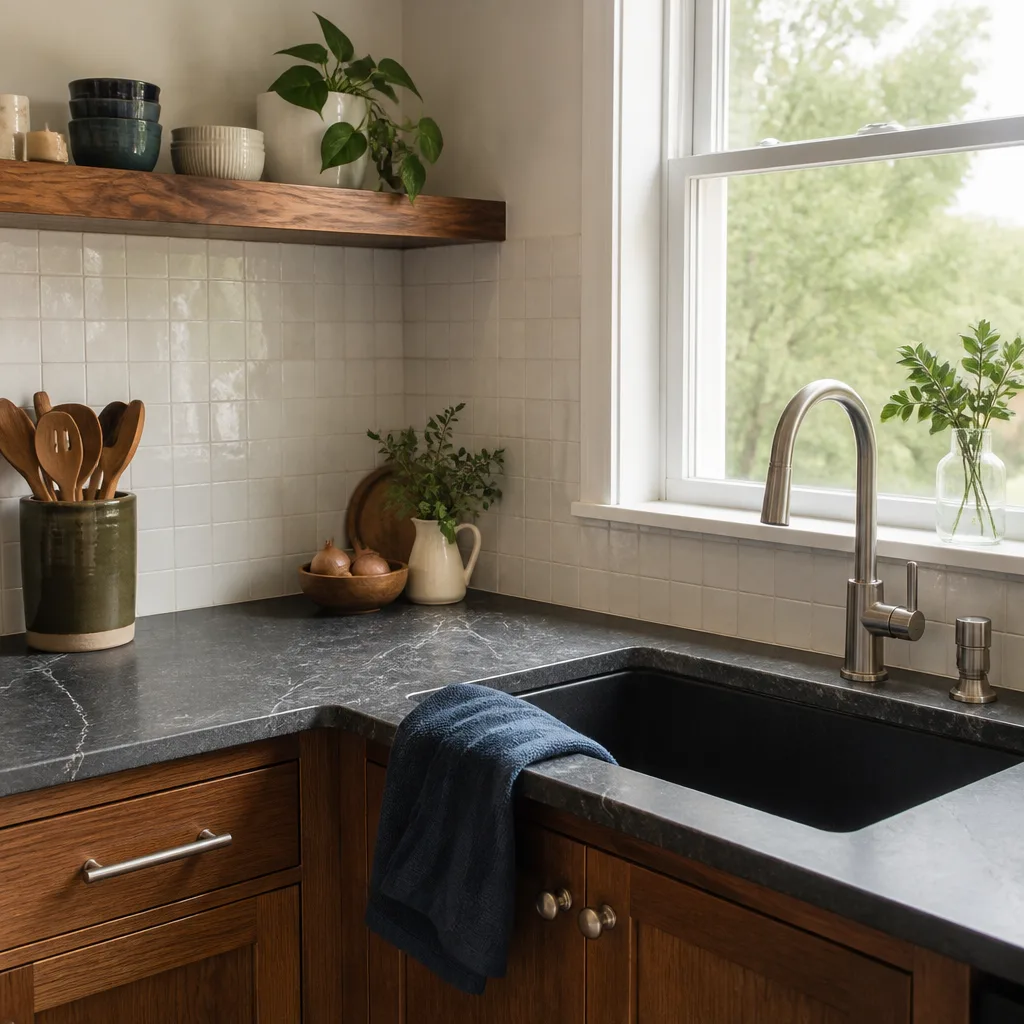
Seam placement on Cambria is where good fabrication separates from average. The goal is to put seams where they’re least visible, least stressed, and aligned with the slab’s pattern so the surface reads as a single piece. On a straight run of base cabinets, that’s usually straightforward. On an island, it’s a planning exercise.
What good seam placement looks like:
- Seams land away from cutouts. A seam that runs near a sink or cooktop cutout weakens the slab at exactly the point where stress concentrates.
- Seams follow the pattern flow. On a Cambria slab with veining or movement, the fabricator should template the layout so the pattern carries across the seam. A seam that interrupts the vein pattern is a seam you’ll stare at for twenty years.
- Island layouts get planned first. A large island often can’t be cut from a single slab, which means you need a seam plan before the slab is ordered. The fabricator should show you the layout on paper, with the seam marked, and get your sign-off.
- Seams sit where hands and eyes don’t land. The best seam is the one you have to hunt for. Ask the fabricator where the seam will sit and why.
We’ve watched McKinney homeowners approve a seam plan on a phone screen, then discover the seam runs through the middle of the island they’ll look at every morning. Ask for the layout in writing on the slab size you’re actually buying.
What Cabinet Prep Has to Happen Before Cambria Goes In?
The cabinet prep is the not-glamorous half of a Cambria install, and it’s usually where the schedule slips. Here’s the honest breakdown of who owns what, so nobody ends up pointing fingers when the slab shows up and the cabinets aren’t ready.
What has to happen before installation day:
- Cabinets set, leveled, and secured to the wall and floor. A cabinet box that shifts after the countertop goes down will crack the slab. Leveling and anchoring happen first, and they’re the cabinet installer’s job, not the countertop fabricator’s.
- Substrate layer installed and measured for flatness. A plywood or other approved substrate layer goes over the cabinet box, and it gets checked with a straightedge. If a cabinet run is out of flat, it gets shimmed or planed before the slab arrives.
- Dishwasher and range roughed in. Appliances that need to clear the countertop opening should be test-fitted before the slab is set. Nobody wants to discover the dishwasher doesn’t fit after the slab is glued down.
- Old countertop and backsplash removed. The tear-out is a separate line on the estimate, and it should be spelled out in writing.
- Clear responsibility in the contract. The written price should say who handles cabinet prep, who handles the substrate, and who handles the tear-out. If those three items aren’t listed, ask before you sign.
This is the part of the job where a McKinney homeowner learns whether the contractor is coordinating the trades or just showing up to set the slab and leaving the cabinet guy to figure it out.
How Do You Register the Cambria Warranty and What Should You Keep?

Cambria’s lifetime warranty is only as good as the paperwork behind it. Registration is the homeowner’s responsibility, and a lot of people never do it. The result is a valid warranty sitting in a drawer, unregistered, with no way to claim it if something fails.
What to collect and keep:
- The Cambria warranty registration confirmation. Register the slab as soon as the install is complete. Keep the confirmation in a file you’ll actually find in three years.
- The slab identification and color name. Your invoice should list the exact Cambria color and slab. Photograph the label on the back or edge of the slab if it’s visible before installation.
- The fabricator’s name and the install date. The warranty trail runs through the fabricator who cut and installed the slab, so keep their name and the install date on file.
- The original written price and any change orders. If there’s ever a dispute about what was installed or when, the signed paperwork is the record.
- Photos of the substrate and install. Before the slab goes down, take a few phone photos of the substrate, the adhesive, and any overhang support. It costs nothing and it settles arguments later.
If your contractor doesn’t hand you the registration information at job close, ask for it before the crew leaves. A squared-away job ends with the paperwork in your hand, not theirs.
When Should You Call a Pro Instead of a General Handyman?
Cambria isn’t a material for a general handyman with a wet saw. The slab is heavy, the specs are specific, and the warranty depends on both. If your project involves a Cambria slab, an overhang longer than a few inches, or a cutout near a seam, that’s a fabricator’s job, not a weekend project.
Call a pro when:
- The countertop is Cambria or another engineered quartz with a manufacturer warranty.
- The island needs a seam plan or an overhang that requires support.
- The cabinet run isn’t flat and needs correction before the slab goes down.
- The job involves a cutout for a sink, cooktop, or dishwasher within a few inches of an edge or seam.
We handle Cambria installs in McKinney as part of full kitchen work, with the substrate, cabinet prep, and seam plan documented before a slab is ordered. Our technicians have up to 22 years of experience, and every project carries the 365-Day Done Right Promise: if the work doesn’t hold within a year, we come back and correct it at no charge. For the broader scope of a kitchen project, see our Kitchen Remodeling in McKinney page. If you’re planning a full remodel, our General Contractor in McKinney page covers the coordination side.
Related services in McKinney: Kitchen Remodeling in McKinney | Bathroom Remodeling in McKinney
What Should You Verify Before Hiring a Cambria Contractor in McKinney?
Before you sign, run this checklist. It takes ten minutes and protects a five-figure investment.
- Ask who fabricates the slab. A qualified Cambria contractor can name the fabricator and confirm they work within Cambria’s program.
- Ask for the substrate flatness spec in writing. The contractor should be able to tell you Cambria’s flatness tolerance and how they measure it.
- Ask how they support overhangs. Specific answers: corbels, brackets, or legs, and at what span.
- Ask what adhesive they use. Cambria-approved, named on the estimate.
- Ask for a seam layout drawing. Especially on an island. Get it before the slab is ordered.
- Ask who handles cabinet prep and tear-out. It should be in the written price.
- Ask for the warranty registration process in writing. If they can’t explain it, they haven’t done it enough.
If a McKinney contractor can’t answer items one through five, that’s your answer. Move on.
The Bottom Line
Cambria is one of the most durable countertop materials you can put in a McKinney kitchen, and it comes with a lifetime warranty that only works if the install meets Cambria’s specifications. The specs cover substrate flatness, overhang support, approved adhesives, and seam placement. The cabinet prep has to happen before the slab arrives, and the warranty registration is on you to complete and keep. Get those four things right and the slab will outlast the kitchen. Skip them and you’ll be calling someone else in a year.
If you’re in McKinney and need help with a Cambria install or a full kitchen project, Bradford Remodeling Co McKinney offers free estimates with a written price before any work starts. Call (844) 834-0609. Start with our Bradford Remodeling Co McKinney home page to see how we work.
Frequently Asked Questions
Cambria countertops in McKinney typically run in the range of $75 to $120 per square foot installed, depending on the slab color, edge profile, and complexity of the layout. Islands with seams and overhangs sit at the higher end because of the fabrication work. Ask for a written, line-item price before any work starts; a real estimate breaks out slab, fabrication, and install separately. Call (844) 834-0609 for an exact quote – estimates are free.
Cambria’s lifetime warranty covers the slab against defects, but it requires the installation to meet Cambria’s substrate and support specifications. If a contractor installs the slab on a substrate that’s out of flat or an unsupported overhang, the warranty can be voided. That’s why the specs matter as much as the slab itself. Before you sign, confirm your contractor knows the flatness tolerance, the support span limits, and the approved adhesives. Call (844) 834-0609 if you want a second set of eyes on a bid.
Cabinet prep, including leveling, anchoring, and installing the substrate layer, is typically the cabinet installer’s responsibility, and it has to be finished and measured before the countertop fabricator arrives. The written price should spell out who handles cabinet prep, who handles the substrate, and who handles the tear-out. If those three items aren’t listed, ask before you sign. Call (844) 834-0609 and we’ll walk through the scope with you.
A typical Cambria countertop install in McKinney takes one to two days for fabrication-ready cabinets, with template usually one to two weeks before install day. The template visit comes first, the slab is cut at the fabricator’s shop, and the install crew sets it on the scheduled day. Cabinet prep and tear-out add time on the front end. Call (844) 834-0609 for a schedule tied to your specific kitchen.
Written by the team at Bradford Remodeling Co McKinney.
Need Construction Help?
Call Bradford Remodeling Co McKinney - the local pro we connect you with is licensed and insured, here with fast after-hours help in McKinney.
(844) 834-0609