

Emergency General Contractor Near Me: What McKinney Homeowners Should Do First
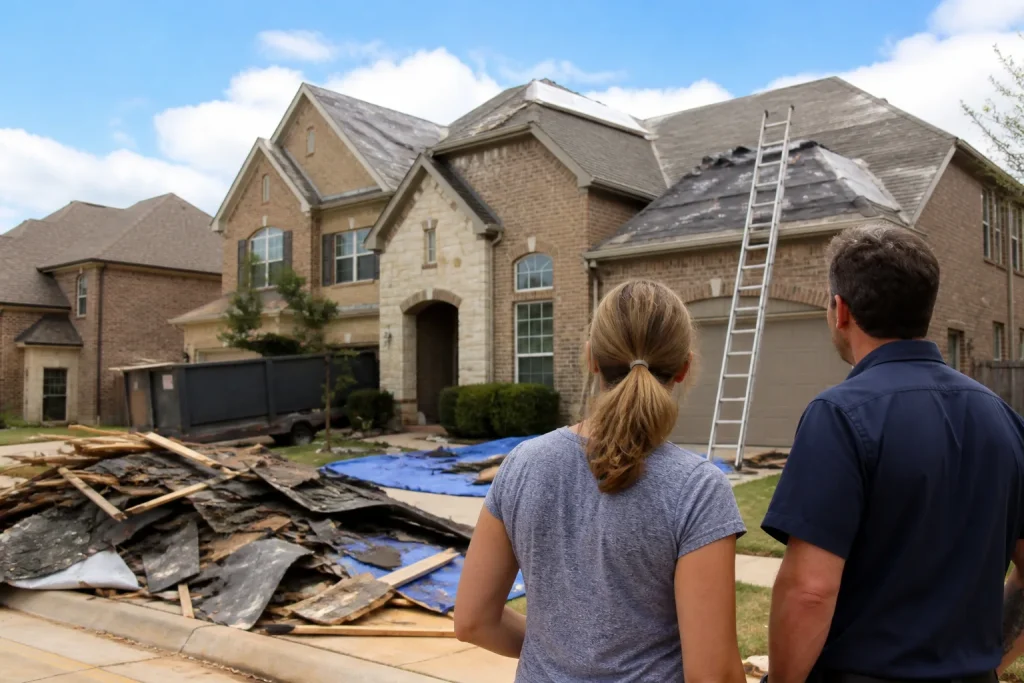
If a contractor knocks on your door within two hours of a storm and slides a direction-of-benefit form across the clipboard, don’t sign it. That form hands your insurance payout to the contractor before anyone has agreed on what the work even is, and it’s one of the most common post-storm fraud tactics in North Texas. The truth is that the general contractor is the fourth call you make after emergency damage, not the first. The first three calls protect your claim. Get those right and the repair goes smoothly. Get them wrong and you can spend a year fighting your own insurance company.
Here’s the sequence, and what to do in each step.
Who should a McKinney homeowner call first after storm or water damage?
Call your insurance company first, a licensed mitigation firm second, and your mortgage servicer third. The general contractor comes fourth. It feels backward when there’s two inches of water on the floor, but the order matters because each of those first three calls protects something the others can’t.
Here’s why the sequence holds up:
- Insurance first. You need a claim number and a claims adjuster assigned before anyone touches the damage. Most policies require you to report damage promptly and to mitigate further damage, but they also require documentation. A claim opened on day one moves faster than one opened on day nine after a contractor has already torn out drywall.
- Mitigation second. Water extraction, drying, roof tarping, and board-up are emergency services that stop the damage from spreading. They’re a separate trade from reconstruction. More on this below.
- Mortgage servicer third. If your home has a mortgage, your lender has a vested interest in the property and is often named on the insurance check. A quick call to your servicer’s loss-draft department tells you how the payout will be handled and whether the check needs to be endorsed by them.
- General contractor fourth. Once the claim is open, mitigation is underway, and you know how the money flows, a GC can scope the rebuild with the adjuster.
We’ve watched homeowners in McKinney’s Stonebridge Ranch and Craig Ranch neighborhoods reverse this order and pay for it. A contractor starts demo on day two, the adjuster arrives on day six and disputes half the scope, and suddenly the homeowner is stuck in the middle with a half-gutted kitchen and a check that doesn’t cover the rebuild.
What is emergency mitigation, and why is it a different contractor from the rebuild?
Emergency mitigation is the work that stops active damage: extracting standing water, setting industrial dryers and dehumidifiers, tarping a compromised roof, and boarding up a broken window or wall. It is not reconstruction. Mitigation is typically performed by a licensed water damage or restoration firm, and reconstruction is performed by a general contractor. They are usually two different companies with two different licenses, and that’s normal.
Why the split matters: a water mitigation firm is licensed and equipped for extraction and drying. A general contractor is licensed and equipped to rebuild the framing, drywall, flooring, and cabinetry after the space is dry. Trying to force one company to do both, or letting a GC start demo before the space is properly dried, is how you end up with mold behind new drywall six months later.
In our experience, the cleanest projects in McKinney follow this path: mitigation firm dries the space, the adjuster and the GC agree on scope and price in writing, and then reconstruction starts. If you need the reconstruction side scoped, that’s the work of a General Contractor in McKinney, and it should always start with a written price, not a handshake.
One more thing on the mitigation call: ask any mitigation firm you hire whether they have a financial relationship with the general contractor they recommend. If they do, you’re within your rights to get an independent scope. You’re not obligated to use whoever the mitigation firm recommends.
What is a direction-of-benefit form, and why should you refuse to sign one?

A direction-of-benefit form, sometimes called a “DOB,” and an assignment of benefits clause, or “AOB,” are documents that transfer your insurance claim payout directly to the contractor. The contractor gets paid by your insurer instead of by you. Sounds convenient. It is one of the most abused documents in storm restoration work in North Texas, and you should refuse to sign one before a scope of work and a written price exist, and honestly, we’d advise refusing to sign one at all.
Here’s what can go wrong when a homeowner signs an AOB:
- The contractor controls the claim. They can negotiate, supplement, and even file suit against your insurer in your name. You lose your seat at the table with your own insurance company.
- The price isn’t locked. Because you’re not paying the contractor directly, some AOB contractors bill the insurer for whatever they can get approved, and you have no leverage to dispute it.
- You lose control of who does the work. If the AOB contractor does poor work, firing them is complicated because your insurer is contractually obligated to them, not to you.
If a contractor shows up uninvited after a hailstorm in McKinney and asks you to sign a DOB before any photos, measurements, or scope exist, that’s a red flag. Legitimate contractors will give you a written scope and a written price and let you hold the check.
This exact concern is why Bradford’s approach is a written price before any work starts, no exceptions. If a contractor won’t put the number on paper, that contractor shouldn’t have your signature on anything.
What documentation should McKinney homeowners gather before any contractor starts work?
Photographs with timestamps, the insurance claim number, the adjuster’s name and contact, and a written scope from the contractor. Without those four, you have no leverage if the work is disputed later. Documentation is the single most powerful thing a homeowner controls in a damage claim.
Our recommendation for the first 24 hours:
- Photos before cleanup. Wide shots of each room, close-ups of damage, and a photo of a newspaper or phone screen showing the date. Timestamps in the file metadata are not always reliable; a visual timestamp helps.
- Video walkthrough. A single continuous video from the front door through every affected room, narrating what you see, is worth more than fifty random photos.
- Insurance claim number and adjuster contact. Written down, not just in your phone, in case the phone is damaged.
- Written scope and price from the contractor. Line-item, not a single lump number. This becomes the document the adjuster reviews inside the claim.
- Contractor license and insurance. More on how to verify below.
We pulled one out of a garage off Virginia Parkway last spring where the homeowner had thirty-two photos and a video and the adjuster approved the entire scope in one visit. The neighbor across the street had six photos and spent three weeks with supplements.
How do you verify an emergency contractor’s license and insurance in real time?

Ask for the license number and the certificate of insurance, then verify both through the issuing body before you sign anything. Do not take a screenshot or a laminated card as proof. Request the actual documents and check them at the source. This takes about fifteen minutes and has saved homeowners we’ve worked with from five-figure regret.
Here’s how to verify each:
- License. In Texas, general contractors are not licensed at the state level, but specialty trades (electrical, plumbing, HVAC) are licensed and regulated by the Texas Department of Licensing and Regulation (TDLR). Ask for the specific trade license if the emergency work involves those trades, and verify it through TDLR’s public search. For the overall project, ask for a written scope and references from McKinney-area jobs you can call.
- Insurance. Request a certificate of insurance that names you as the certificate holder and lists general liability AND workers’ compensation. Call the agent number on the certificate (not the number the contractor gives you) and confirm the policy is active for the date the work starts.
- Background-checked technicians. Ask who will be on site. Bradford’s technicians are background-checked and uniformed, and homeowners know who is coming before the crew arrives. That’s not standard across the industry; make it a requirement.
- Written guarantee. Ask exactly what the guarantee covers, for how long, and what triggers a free return visit. Bradford’s 365-Day Done Right Promise covers every completed project for a full year; if the work fails inside that window, we return and correct it at no charge.
If the contractor can’t answer any of these without hesitation, move on.
When should you call a pro instead of handling it yourself?
Call a pro the moment structural elements, electrical, plumbing, or gas lines are involved. Wet drywall after a burst pipe is one thing. A compromised load-bearing wall, exposed wiring, or a torn gas fitting is another, and those need licensed specialists the day of, not the week after. We are not the first call for those; a licensed plumber, electrician, or structural engineer is. We’re the call for the rebuild.
The other clear “call a pro” moment: when the scope is bigger than one room, when the insurance adjuster needs a written bid, or when your own labor would void a manufacturer’s warranty on materials like James Hardie siding or GAF roofing products. Documented brands with real manufacturer warranties only stay covered if the install follows the manufacturer’s spec, and that’s a professional’s job.
Related services in McKinney: if the damage is confined to one space, a Kitchen Remodeling in McKinney or Bathroom Remodeling in McKinney scope covers the rebuild of that room with a written price before any tear-out. If the damage runs through multiple rooms or the exterior, that’s whole-home work, and you can see the full scope of what we handle on our Bradford Remodeling Co McKinney home page.
The Bottom Line
The order of calls after emergency damage in McKinney is not a suggestion; it protects your claim. Insurance first, mitigation second, mortgage servicer third, general contractor fourth. Refuse to sign any direction-of-benefit form before a written scope and price exist, and honestly, refuse them altogether. Document before cleanup. Verify license, insurance, and background-check status before anyone steps onto your property. That’s what being squared away looks like.
If you’re in McKinney and need help, Bradford Remodeling Co McKinney offers free estimates. You’ll get a written price before any work starts, a live person answers the phone any hour, and every completed project comes with the 365-Day Done Right Promise in writing. Call (844) 834-0609 to schedule your free estimate.
Frequently Asked Questions
Emergency water mitigation in the McKinney area typically runs $1,500 to $6,000 for a room-scale event (extraction, drying equipment for three to five days, and basic antimicrobial treatment), and the number climbs above $10,000 when multiple rooms or a slab leak are involved. Most homeowners insurance policies cover mitigation as part of the claim, so your out-of-pocket is usually the deductible. Get a written, line-item estimate from the mitigation firm before they start, and call (844) 834-0609 for a free estimate on the reconstruction side; estimates are free.
No. Do not sign a direction-of-benefit form or any assignment-of-benefits clause before a written scope of work and written price exist, and we recommend declining them altogether. Signing one hands your insurer’s payout to the contractor and reduces your control over the claim, the price, and who does the work. If a McKinney contractor pressures you to sign one on the spot, that’s a reason to find another contractor. Call (844) 834-0609 for a free estimate and a written scope first.
Most standard homeowners policies cover both mitigation (the emergency work that stops further damage) and reconstruction (the rebuild), subject to your deductible and any coverage limits. Flood damage is the common exception; standard policies exclude rising water and you’d need separate flood coverage through the NFIP or a private carrier. Your adjuster will confirm coverage in writing, and a written contractor scope helps the adjuster approve the rebuild. Call (844) 834-0609 for a free estimate with written line items your insurer can review.
A single-room rebuild (kitchen or bathroom, water damage repair and finish) typically takes two to five weeks once the space is dry and the scope is approved. Whole-home or exterior damage (roof, siding, framing) runs six weeks to three months depending on material lead times and permit inspections. The timeline starts when mitigation is complete and the adjuster approves the scope, not when the contractor first arrives. Call (844) 834-0609 for a free estimate and a written timeline you can hold us to.
Written by the team at Bradford Remodeling Co McKinney.
Need Construction Help?
Call Bradford Remodeling Co McKinney - the local pro we connect you with is licensed and insured, here with fast after-hours help in McKinney.
(844) 834-0609