
Last updated November 18, 2026








Free written scope consultation - allowances, timeline, and change-order rules on paper before a single trade is scheduled
Bathroom Remodeling Maintenance Schedule: What to Do and When
The most expensive bathroom repairs start with a $4 tube of caulk that should have been replaced at 18 months. The water damage behind it compounds quietly until it hits the subfloor. A remodeled bathroom is not one thing; it’s a system of materials running on different clocks. Grout, caulk, exhaust fans, and valve cartridges each have their own service interval, and missing them shortens the life of everything around them. This guide gives you the actual calendar we use on McKinney jobs, not a vague “check for leaks” checklist.
Quick Answer
A bathroom remodel needs ongoing maintenance on four clocks: caulk and silicone joints resealed every 12 to 18 months, grout resealed every 12 months (sanded) or 6 to 12 months (unsanded), exhaust fan CFM verified once a year with the duct cleaned, and supply lines and valve cartridges inspected at 5 years and replaced at 7. Everything else falls around those anchors. In McKinney’s climate, with its hard water and long humid summers, those intervals are the ceiling, not the goal.
Styles & brands we work with
- Kitchen remodeling
- Bathroom remodeling
- Home additions & ADU
- Roofing
- Windows & doors
- Driveway & pavers
- Fence
Table of Contents
- What you check every month (and what you never touch)
- Grout: why sanded and unsanded need different schedules
- Caulk and silicone: the 18-month clock
- Exhaust fan CFM verification
- Valve cartridges and supply lines
- Natural stone versus porcelain and solid-surface surrounds
- What maintenance protects your warranty
- The full month-by-month and annual calendar
What You Check Every Month (and What You Never Touch)
A monthly walkthrough takes five minutes. It’s not a repair session; it’s an observation pass. We’ve seen homeowners turn a $0 inspection into a $400 leak by tightening a supply line that was already failing. The point is to see, log, and decide.
Run this once a month:
- Look at the caulk line where the tile meets the tub, shower pan, or floor. Run a finger along it. If it flakes, gaps, or pulls away, it’s done.
- Check the grout lines on the shower floor and the two rows of wall tile above the pan. Darkened grout here means moisture is sitting in the substrate.
- Press a dry paper towel against the base of the toilet and the supply line behind it. Any dampness is a call to action, not a “wait and see.”
- Turn the exhaust fan on and hold a tissue to the grille. If the tissue won’t stay up, airflow is failing.
- Check under the sink cabinet for staining on the cabinet floor, especially around the P-trap and shutoff valves.
- Look at the ceiling below the bathroom, if you have access. Fresh paint or bubbling there is an alarm.
What you never do in a monthly pass: tighten fittings, re-caulk over failing caulk, scrub grout with acid cleaners, or adjust the valve cartridge. Those are scheduled tasks handled once per interval, done correctly, not improvised.
Grout: Why Sanded and Unsanded Need Different Schedules
Sanded and unsanded grout are different materials with different failure modes, and the wrong sealer on the wrong grout accelerates cracking. This is the mistake we see most in McKinney remodels, usually on a job that was done by a prior contractor and inherited by a frustrated homeowner.
Sanded grout contains fine aggregate. It’s used on joints 1/8 inch and wider. It’s porous, it holds moisture longer, and it should be sealed every 12 months with a penetrating sealer that soaks in rather than coating the surface. A film-forming sealer (what some “grout sealers” actually are) sits on top, traps moisture under it, and accelerates the cracking it was supposed to prevent. Penetrating only.
Unsanded grout is used on joints narrower than 1/8 inch, typically polished stone and glass tile, because sand would scratch the surface. It’s denser and less porous but more brittle. It should be sealed every 6 to 12 months, and it cannot tolerate a sealer with a surface build.
A grout maintenance check happens once a year at minimum, more often if you see:
- Hairline cracks along a grout line at the shower floor (flexing substrate, usually from water under the pan)
- Efflorescence, that white powdery film, which means water is pushing through and evaporating (a moisture problem, not a cleaning problem)
- Grout that crumbles when scraped with a fingernail (the grout is failing, not just dirty)
If you have a McKinney bathroom with an older tile install and you’ve never sealed it, the first call isn’t to a cleaner. It’s to a remodeler who can look under it. That’s a Bathroom Remodeling in McKinney conversation, not a cleaning job.
Caulk and Silicone: The 18-Month Clock
Every caulk joint in a wet area should be replaced at 18 months, or sooner if it’s showing failure. That’s not a manufacturer’s suggestion; it’s the interval we work to on jobs scheduled for a return visit under the 365-Day Done Right Promise. If a caulk joint fails inside that first year, we come back and redo it at no charge. But the calendar after the guarantee period is the homeowner’s, and 18 months is the interval.
Why so short? Caulk in a shower takes a beating no other caulk joint in a house does. Constant wet-dry cycling, soap scum, and the McKinney hard water that leaves mineral deposits on every surface. The mineral buildup alone degrades the surface of the caulk well before it visibly peels.
Two types matter:
- Paintable acrylic-latex caulk: correct for dry zones like the joint between a painted wall and a tile wall outside a shower. Replace every 3 to 5 years.
- 100% silicone (or a quality siliconized urethane): required for the tub-to-wall joint, shower pan perimeter, floor-to-wall joints in the shower, and any change-of-plane joint. Replace every 18 months.
The right way to replace silicone is a full removal of the old bead with a plastic scraper, a wipe with denatured alcohol, a full cure before the shower is used again (usually 24 hours), and a bead of silicone applied in one continuous pass. Caulking over old silicone is the single fastest way to fail the joint inside 60 days. It doesn’t bond to itself.
Silicone failures we see in McKinney, in order of frequency: cracked bead at the shower pan corner because the pan flexes and the installer used a rigid caulk; mold under the bead because the joint was caulked over a wet surface; and peeling at the tub because the surface was never cleaned before the original bead went down.
Exhaust Fan CFM Verification
An exhaust fan that pulled 110 CFM on day one is not pulling 110 CFM at year five. The motor degrades, the blades collect lint, and the duct path holds debris. In our experience the combination can cut real airflow by 30 to 50 percent. Inadequate ventilation is the leading cause of mold behind tile, and mold behind tile is the leading reason a bathroom remodel gets torn back open.
CFM stands for cubic feet per minute, the measurement of how much air the fan moves. The code minimum for a bathroom is 50 CFM for intermittent use or 20 CFM continuous; most full bathroom remodels step up to 80 to 110 CFM for a shower-sized room. Verifying the actual CFM once a year is a 10-minute task if you know what you’re doing. It’s also the most skipped maintenance task in a remodeled bathroom.
The annual verification checklist:
- Turn the fan on and hold a piece of tissue against the grille. If it holds, you have airflow. If it drops, the fan is failing or the duct is blocked.
- Pull the grille and clean it in warm soapy water. Grilles collect a surprising amount of debris and are the cheapest airflow fix in the schedule.
- Check the duct path if accessible. Flexible duct with a sag or a kink loses most of its capacity. Duct runs over 10 feet with more than one 90-degree bend should be upgraded to rigid metal.
- Confirm the fan exhausts outdoors. A fan ducted into the attic is not a fan; it’s a mold generator. This is common in older homes around McKinney, particularly in additions built before the current code cycle.
- Replace the fan motor or the entire unit if the tissue won’t hold after a cleaning. A new fan upgrade to 110 CFM is the standard fix.
The good news: a fan motor is one of the few bathroom components where replacement is straightforward and inexpensive. The failure mode we’d rather avoid is a homeowner waiting until the ceiling below is stained.
Valve Cartridges and Supply Lines
Most catastrophic water damage in a remodeled bathroom starts at a braided supply line that was never replaced after 7 years. The cartridge inside the valve body is the second most common culprit. These two components live behind the wall and under the sink, which is why they get ignored, and why they cause the worst leaks when they finally fail.
Here’s the schedule we give every McKinney homeowner:
- Years 1 to 5: inspect annually. Look for corrosion on the fitting, bulging in the braid, dampness around the nut, and mineral buildup at the cartridge where it meets the trim.
- Year 5: inspect the cartridge operation. If the handle feels gritty, drips at the trim, or the temperature is hard to control, replace the cartridge now. A cartridge replacement takes an hour; a cartridge failure while you’re on vacation takes a bathroom down to the studs.
- Year 7: replace all braided stainless supply lines. Every one. They have a service life of 5 to 7 years, and braided stainless lines fail without warning. This is the most ignored maintenance task in the entire schedule.
- Year 10: replace the valve cartridge regardless of feel. The internal seals degrade from McKinney’s hard water and the failure is progressive.
If you have a shower valve with a cartridge type that’s no longer made, replace the valve when you replace the cartridge. That’s a wall-opening job, and it’s a good moment for a General Contractor in McKinney to assess the rest of the rough-in while the wall is already open.
One safety note on the plumbing behind the wall: water under pressure doesn’t announce itself until it’s already leaked. We do not recommend homeowners turn a stuck valve or re-seat a cartridge that’s resisting. A cross-threaded fitting at pressure can fail the wall open. That’s a job for a trained plumber.
Natural Stone Versus Porcelain and Solid-Surface Surrounds
The surround material changes the maintenance schedule more than anything else in the bathroom. Three common materials, three different clocks, and using the wrong maintenance product is the fastest way to void a finish or a material warranty.
Porcelain tile: the most forgiving material in the room. It doesn’t need sealing. It needs a non-abrasive cleaner and grout upkeep. Clean the tile with a pH-neutral cleaner once a week; do not use anything with acid (including vinegar) or anything with abrasives. Acid etches the glaze and the grout under it. Porcelain’s grout is the maintenance item, not the tile.
Natural stone (marble, travertine, quartzite): the most demanding material in the bathroom. Stone is porous, and it needs a penetrating sealer every 6 to 12 months depending on the stone and the product. Acid in any form (lemon, vinegar, most tile cleaners) etches marble and travertine permanently. A stone shower needs squeegee-after-use discipline and a mild stone-specific cleaner. If the stone is polished marble in a shower, expect a re-hone every 8 to 12 years.
Solid-surface surrounds (Corian-type products): the lowest maintenance surround in the schedule. Non-porous, no sealing, and most scratches sand out. The tradeoff is heat: a hot pan or a high-heat hair tool on the surface leaves a mark that needs professional re-finishing. Solid surface also has a color-through composition, so a scratch that doesn’t cut deep can be buffed out.
The finish choices you make at install time set the maintenance load for the next 15 years. That’s the conversation to have before a full remodel, whether that’s a Kitchen Remodeling in McKinney project that’s including a bathroom or a dedicated Bathroom Remodeling in McKinney scope.
What Maintenance Protects Your Warranty
Every completed Bradford Remodeling Co McKinney project carries the 365-Day Done Right Promise, a full-year written guarantee. If the work fails inside that window, we come back and correct it at no charge. The guarantee says what it covers, and it’s in the homeowner’s hands in writing at close. What it does not cover is work that fails because a maintenance interval was skipped after the guarantee period, or a material failure caused by the wrong product being used on it.
The maintenance tasks that preserve a workmanship warranty:
- Replacing silicone caulk joints on the 18-month clock, using the correct product
- Annual grout sealing with a penetrating sealer, not a film-former
- Annual exhaust fan verification and duct cleaning
- Replacing braided supply lines at 7 years
- Using only pH-neutral cleaners on the tile and stone surfaces
Tasks a homeowner can skip without consequence to the warranty:
- Cosmetic polishing of stone in non-wet zones
- Annual deep-cleaning of the tile if the surface is intact
- Resealing porcelain (it doesn’t need it; skip it)
- Replacing the toilet flapper on the manufacturer’s interval (a plumbing consumable, not a remodel item)
The line between those two lists is straight: anything that keeps water out of the substrate or keeps air moving through the room is warranty-relevant. Anything else is a household chore. If you’re not sure which bucket a task falls in, call us at (844) 834-0609 and we’ll tell you plainly. The answer is free.
The Full Calendar: Month-by-Month and Annual
Here’s the maintenance calendar we recommend, built for a fully remodeled bathroom in the McKinney climate. Print it; put it inside a cabinet door; run it once a month.
Monthly
- Visual caulk check along every wet joint
- Grout line check on the shower floor and the two rows above the pan
- Paper-towel dampness check at the toilet base and the under-sink supply lines
- Exhaust fan tissue test
- Under-sink cabinet inspection for staining or mineral buildup
- Ceiling-below inspection, if accessible
Quarterly
- Clean the exhaust fan grille
- Clean the shower door track and check the door seal
- Check the showerhead for mineral buildup (soak in white vinegar if flow is reduced)
- Test the GFCI outlet in the bathroom (press the test button, confirm the reset)
- Inspect the toilet flapper and fill valve for tank-to-bowl leaks
Annually
- Reseal sanded grout with a penetrating sealer (every 12 months)
- Reseal unsanded grout (every 6 to 12 months)
- Reseal natural stone with a penetrating sealer (every 6 to 12 months)
- Verify fan CFM with a tissue test after cleaning; replace motor or fan if it fails
- Inspect the valve cartridge operation at every faucet in the room
- Inspect all braided supply lines for corrosion or bulging
- Check the outside exhaust vent termination (the flap should move freely when the fan is on)
Every 18 Months
- Replace the silicone bead on every wet-zone change-of-plane joint
Every 5 to 7 Years
- Year 5: cartridge inspection (replace if gritty or leaking)
- Year 7: replace every braided supply line
- Year 10: replace valve cartridges regardless of condition
Every 8 to 12 Years
- Re-hone polished marble in a wet zone
- Re-grout the shower floor if efflorescence or visible erosion has set in
If you’re in the middle of a Bradford Remodeling Co McKinney home scope that touches the bathroom, this calendar should be part of your closeout documentation. Every Bradford project closes with a clean site, a documented scope, and a signed written guarantee. The maintenance calendar is the next chapter after that closeout.
Common Mistakes to Avoid
- Caulking over old silicone. New silicone won’t bond to cured silicone, so the joint fails within 60 days. Strip the old bead, clean, then caulk. Every time.
- Using a film-forming sealer on sanded grout. It traps moisture under the surface, which accelerates cracking. Penetrating sealer only. This is the most common mistake we see on inherited jobs in McKinney.
- Ignoring braided supply lines past year 7. The failure is invisible until it breaks. Replace them on schedule, not on failure.
- Skipping the exhaust fan because “it’s still running.” A running fan and a venting fan are different things. Verify the airflow, not just the motor noise.
- Cleaning marble or travertine with vinegar. Acid etches marble permanently. A $6 bottle of vinegar can cost a $400 re-hone of a shower wall.
- Assuming porcelain grout lines are sealed because the grout has a sealer in the mix. Factory-sealed grout still needs reapplication. Check the grout manufacturer’s interval and follow it.
- Waiting for the ceiling to stain before looking at the fan duct. By the time the ceiling shows the leak, the moisture damage has already been running for months.
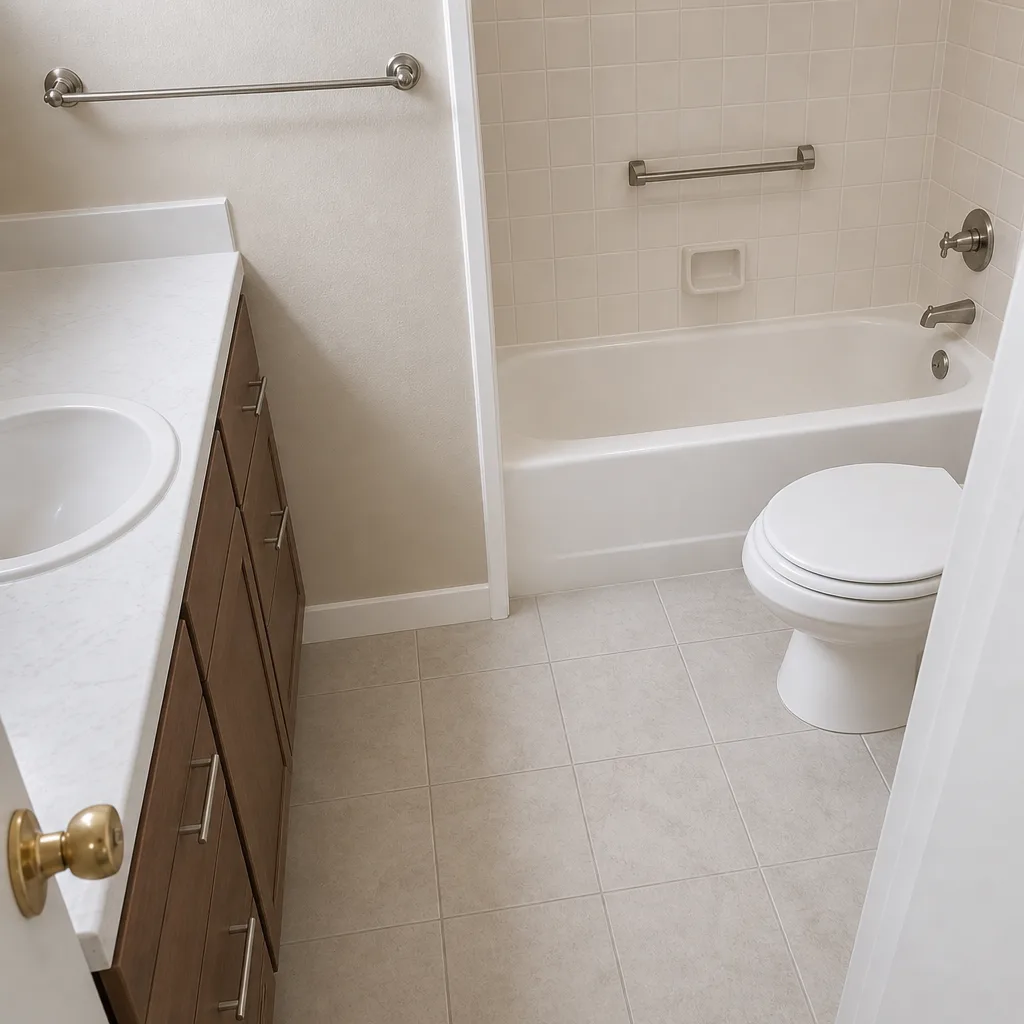
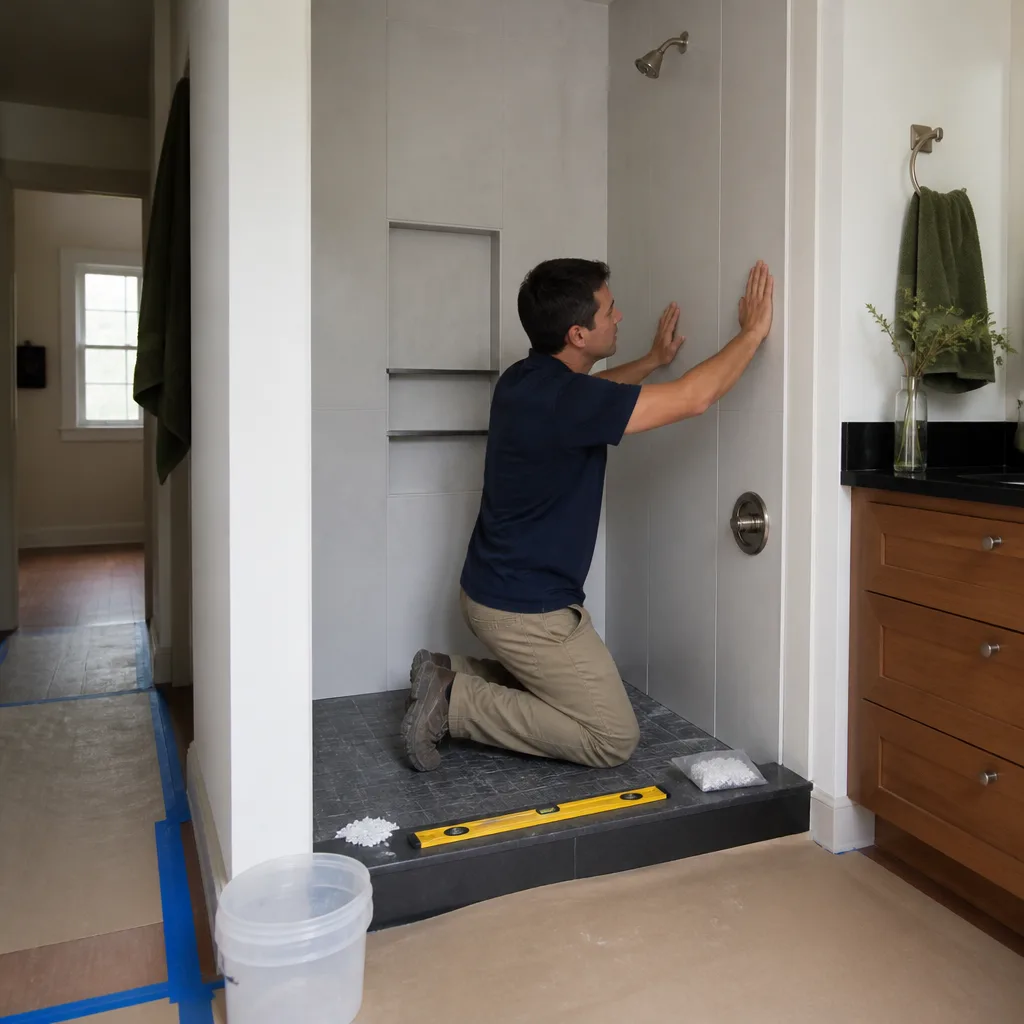
See the difference
 Before
 After
 Before
 After
 Before
 After
When to Call a Professional
Call a professional when you’re past the diagnostic stage of the checklist: grout that’s cracked at the shower floor (a substrate question, not a cleaning task), caulk that’s failed after re-caulking correctly (the joint is moving, and the reason matters), an exhaust fan that won’t hold a tissue after a full cleaning (the duct or the motor has failed), a cartridge that won’t hold temperature, or any sign of moisture under the tile or at the drywall below the bathroom. Those are the failures that compound in a McKinney summer, when a humid bathroom with a failed fan becomes a mold remediation project before the calendar turns.
Bradford Remodeling Co McKinney offers free estimates in McKinney. Every estimate is a written, line-item price before any work starts, and every completed project carries the 365-Day Done Right Promise in writing. Call (844) 834-0609 to schedule your free estimate. A live person answers, not a voicemail.
Frequently Asked Questions
Every 18 months for the silicone joints in the wet zone (shower pan perimeter, tub-to-wall, and floor-to-wall changes of plane), and every 3 to 5 years for paintable acrylic caulk in dry zones. Replacing the full bead at 18 months is the schedule that prevents the failure-and-teardown cycle. If the joint fails inside the first year of a Bradford project, the 365-Day Done Right Promise covers a return visit at no charge. Call (844) 834-0609 for an exact quote on re-caulking if you’re past the guarantee period. Estimates are free.
No. Porcelain tile is glazed and doesn’t need sealing. The grout does. Sanded grout at 1/8 inch or wider needs resealing every 12 months, and unsanded grout under 1/8 inch needs resealing every 6 to 12 months, and using the wrong sealer on either accelerates cracking. Skip the porcelain, seal the grout.
The motor degrades and the duct path collects lint and debris, and in our experience the combination cuts real airflow by 30 to 50 percent over five years. That’s why inadequate ventilation is the leading cause of mold behind tile in McKinney. The fix is a grille cleaning first, a duct inspection second, and a motor or full-fan replacement if the tissue test still fails. Call (844) 834-0609 if the fan needs replacement or the duct needs rerouting; estimates are free.
Supply lines at 7 years, and the cartridge inspected at 5 and replaced at 10, or sooner if the handle is gritty or dripping at the trim. Braided stainless supply lines fail without warning, and most catastrophic bathroom water damage starts at one that was never replaced. This is the task homeowners skip most often. If you’re unsure how old your fixtures are, a single bathroom inspection is worth the call. (844) 834-0609, and the estimate is free.
Skipping the maintenance intervals it depends on: caulk past 18 months, grout never resealed, a failed exhaust fan never addressed, or supply lines past 7 years that could have been replaced. Using acid or abrasive cleaners on marble, travertine, or stone-look finishes is the other common void. The written guarantee spells out exactly what it covers and for how long, and the maintenance list that preserves it is in your closeout packet.
That’s usually not a grout problem; it’s a substrate problem, meaning the shower pan is flexing or water is getting under the tile. Cleaning and re-caulking won’t fix it, and re-grouting will crack again. Call (844) 834-0609 for a free estimate. We’ll tell you plainly whether it’s a spot repair or a bigger scope before any work starts.
The Bottom Line
A remodeled bathroom is a system of clocks. Caulk runs on 18 months, grout on 12 (sanded) or 6 to 12 (unsanded), the exhaust fan on annual CFM verification, supply lines on 7 years, and valve cartridges on 10. Miss them and the failure compounds silently into a subfloor, a mold remediation, or a shower down to the studs. Catch them and a five-minute monthly pass plus a couple of annual tasks protects the materials, the investment, and the written workmanship guarantee that came with the job. That’s the discipline part of the job, and it’s yours to run once we hand over the keys.
If you’re planning a McKinney bathroom scope, or a broader Bradford Remodeling Co McKinney home project that includes one, we write the price and the guarantee down before we pick up a single tool. Call (844) 834-0609 for a free estimate.
Written by the team at Bradford Remodeling Co McKinney.